I need to start by saying, I love bike trails. About a decade ago, I took up with some people who were doing a weekly casual bike ride they called “Bicycle Beer Time”: ride the Border-to-Border trail from Ann Arbor to Ypsilanti, have a beer and some snacks at Corner Brewery, then ride back home. Before that, I was not much of a bike person, but the ride sounded fun, the people seemed cool, and - critically - the route was easy, safe, and comfortable.
It turned out to be a gateway to much bigger things. It was with this same group of people that I rode on my first multi-day bike tour, a week long ride from Ann Arbor to Traverse City. (We’ve done similar adventures almost every year since then, all over the US and even in Europe). I became a dedicated bike commuter. It’s through bikes that I met and continue to meet some of my favorite people in the world.
So, it’s not an exaggeration to say that the B2B trail changed my life.
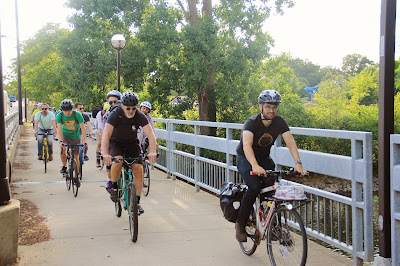 |
| The author on the B2B trail, port-ing a pie to a pedal-powered picnic. (Photo credit: Bike-In) |
Knowing that, you’d probably think I’d be in favor of more bike trails - and generally speaking, I am. Indeed, when I first started hearing about the “Allen Creek Greenway” project that has since become The Treeline, I thought it sounded great, though I didn’t really dig very far into the details. This all changed when, in mid-2017, the city released its Framework Plan (which was then revised into the Treeline Master Plan and formally adopted by City Council later that year). As I read further and further into this document, my feelings shifted from excitement to incredulity and even a bit of anger: the price tag and proposed design seemed… preposterous; the plan was completely out-of-scale with what would make sense for Ann Arbor.
Even so, for a long time I’ve hesitated to speak out publicly against The Treeline, because as an advocate for safe bike infrastructure, I’ve become conditioned to take whatever I can get. Opposing a project simply because it’s an expensive and suboptimal design is a hard stance to take when the alternative may well be a big pile of nothing. However, it’s become increasingly clear that The Treeline is worse than that; it threatens some of the most critical work our community is undertaking to address the crises of our time - housing affordability, climate change, and - counterintuitively - bike and pedestrian safety. My concerns fall into four key areas:
- It began as, and continues to be, a means to reject development of badly-needed housing
- Its design represents an outmoded, car-centric way of thinking
- The cost - and opportunity cost - is massive
- It does not address non-motorized mobility in underserved areas of our community
Before I go any further, I should point out that these criticisms apply to the current advocacy efforts around The Treeline (e.g. from the Treeline Conservancy, the private nonprofit set up to pursue implementation of the trail), and to the Treeline Master Plan. There is certainly some value, however, in the core idea of a north-south "urban trail" through Ann Arbor. I believe that by eliminating expensive elevated structures and re-envisioning The Treeline as a ground-level and substantially on-street corridor, it can be salvaged into a much simpler, less expensive, and ultimately more useful amenity.
The Treeline vs Affordable Housing